About the author
Published January 12, 2026 · Last reviewed April 26, 2026 · 15 min read
In this article · 6 sections
To get past analysis paralysis, you have to break the overthinking cycle by giving your decision-making process some hard limits. This usually means capping your research time, picking an option that’s good enough instead of perfect, and taking small, concrete steps to get the ball rolling.
Why We Get Stuck in Analysis Paralysis
Ever found yourself so deep in a research rabbit hole that you completely lost the will to make a choice? You’re not alone. That feeling of being frozen by too many options or too much information is the heart of analysis paralysis. It’s a state where the fear of making the wrong call completely overpowers your desire to move forward.
This isn’t just simple indecisiveness; it's a deep-seated psychological reflex. Our brains are hardwired to avoid risk, and in a world overflowing with information, every little choice can feel like a high-stakes gamble. The pressure to find the one "perfect" solution can kill your momentum on everything from huge career moves to something as small as picking a new productivity app.
The Fear of the Wrong Choice
At its core, analysis paralysis is a nasty cocktail of perfectionism and fear. We tell ourselves that with just one more article, one more review, or one more opinion, we'll finally uncover the flawless answer. But that quest for absolute certainty is a mirage.
The truth is, doing nothing is often the riskiest choice of all. While you're stuck weighing every pro and con, opportunities are sailing right past you. This is made worse by what experts call decision fatigue, where the sheer number of choices just drains your mental battery, making it even tougher to pull the trigger. For a closer look, you can learn more about decision fatigue in our related article.
The real problem is we treat every decision like it's permanent and irreversible. We forget that most choices aren't final exams—they're learning opportunities. The goal isn't to be perfect; it's to be in motion.
This pattern is incredibly common. In fact, research shows a staggering 85% of people experience decision-making distress, often spiraling into analysis paralysis that grinds their progress to a halt. The same studies show that just setting a realistic deadline can slash this paralysis by up to 40% in a work environment, forcing a much-needed shift from endless thinking to decisive action. You can discover more insights about decision-making distress on plan.io.
Understanding this psychological trap is the first real step toward breaking free.
7 Practical Frameworks for Decisive Action
Sometimes, sheer willpower isn't enough to pull yourself out of the overthinking quicksand. What you really need is a new mental toolkit. Instead of spinning your wheels searching for the "perfect" answer (spoiler: it usually doesn't exist), you can use a few battle-tested frameworks to slice through the mental clutter and just decide.
Think of these as shortcuts that help you build momentum and make choices with confidence, not stress.
This decision tree gives you a great visual for navigating that all-too-familiar path from having options to getting completely stuck.
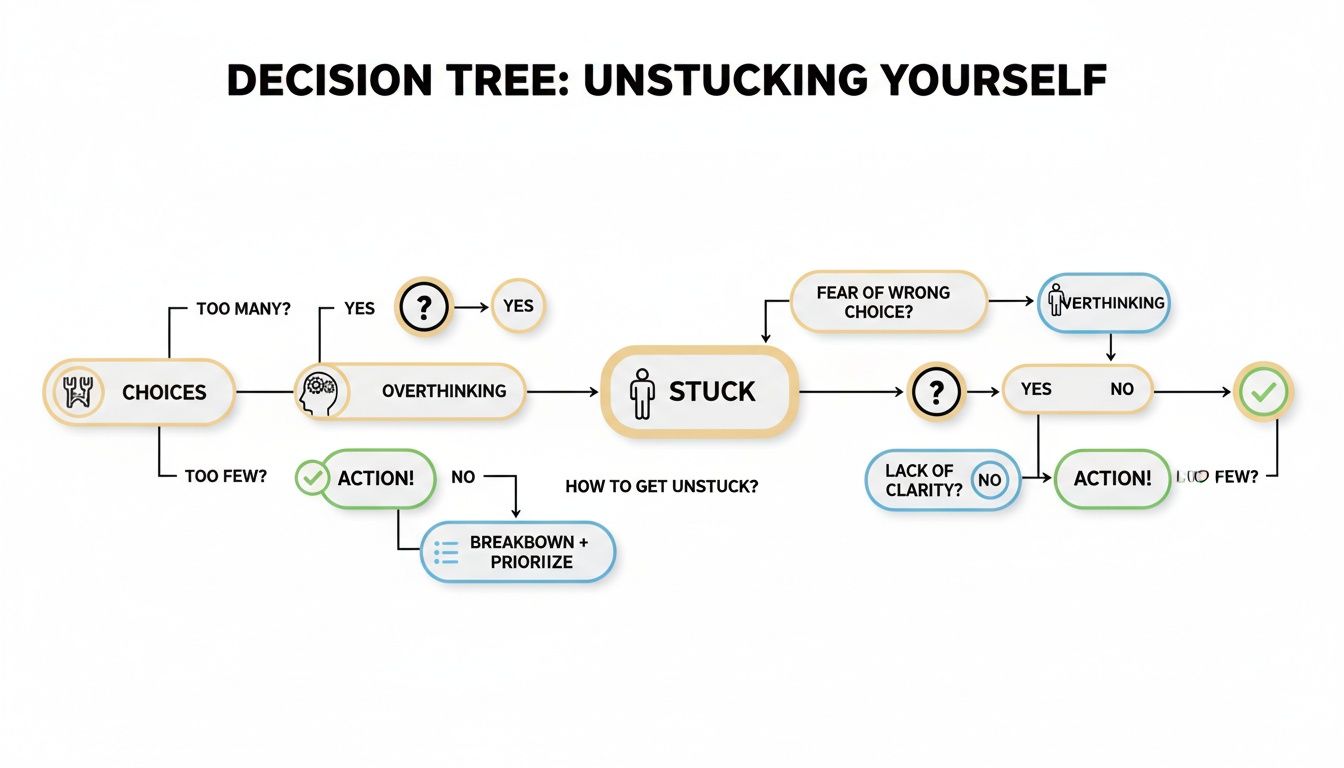
It’s a perfect illustration of how too many choices can lead straight to paralysis if you don't have a system to handle them. Let's build that system.
Embrace "Good Enough" with Satisficing
One of the most liberating things you can do is learn to satisfice. It's a term coined by economist Herbert Simon, and it's simple: choose the first option that meets your essential criteria, not the absolute best one in the universe.
I see this all the time. Someone needs a new project management tool. Instead of spending days comparing 30 different platforms, just define your non-negotiables. Maybe you need a simple interface, calendar integration, and a decent mobile app. The very first tool you find that checks those three boxes? That's your winner. Move on. You just saved hours and made a perfectly solid choice.
Create Urgency with Timeboxing
Another game-changer is timeboxing. This is all about setting a hard, non-negotiable deadline for making the decision. If you don't, the task will inevitably expand to fill all the time you give it—that’s Parkinson's Law in action.
Let's say you're planning a weekend trip. Give yourself exactly one hour. One hour to research spots, find a place to stay, and book it. This forces you to zero in on what truly matters and stops you from falling down the rabbit hole of a thousand travel blogs and hotel reviews.
The goal isn't to rush into a bad decision. It's about recognizing that agonizing for another three days rarely leads to a significantly better outcome. It’s about making a good choice now instead of a theoretically perfect one never.
Sort Your Choices with the Two-Way Door Rule
Jeff Bezos made this mental model famous, and it’s brilliant for sizing up risk. A "one-way door" decision is a big deal and almost impossible to reverse (like selling your company). But a "two-way door" decision? That's easily reversible if it doesn't pan out (like trying a new social media strategy).
Guess what? Most of our daily and weekly decisions are two-way doors. Once you start labeling them as such, the stakes feel so much lower. You can make a choice quickly, knowing you can always pivot or walk back through that door if you need to.
The business world is filled with cautionary tales. A staggering 65% of business leaders get trapped by overanalyzing data. That paralysis isn't just frustrating; it can slash annual revenue by up to 15%.
Experts have found a way around this: set pre-defined stopping rules. For instance, agree to move forward once an option meets 80% of your ideal criteria. This simple trick can cut analysis time by a whopping 40% without any real drop-off in outcomes. If you're curious about how companies put this into practice, you can read the full research on data analysis paralysis from Riskonnect.
To help you get started, here are a few frameworks you can put into practice right away.
Decision-Making Frameworks to Try Today
This table breaks down some of my favorite, practical frameworks to help you move from stuck to unstuck. Find the one that fits your current situation.
| Framework | Core Principle | Best For |
|---|---|---|
| Satisficing | Choose the first option that meets your minimum criteria. | Making "good enough" decisions quickly, like picking a restaurant or software. |
| Timeboxing | Set a strict time limit for research and decision-making. | Preventing tasks from dragging on, like planning a project or a vacation. |
| Two-Way Door Rule | Differentiate between reversible and irreversible decisions. | Lowering the stakes on low-risk choices and focusing energy on high-risk ones. |
| The 10/10/10 Rule | How will this decision feel in 10 minutes, 10 months, and 10 years? | Gaining long-term perspective and overcoming short-term emotional reactions. |
Each of these tools is designed to do one thing: get you out of your head and into action. Try one out the next time you feel yourself starting to spin. You might be surprised at how quickly you can move forward.
Letting Go of Perfection to Move Forward
If there's one thing that fuels analysis paralysis more than anything else, it's perfectionism. It’s that nagging little voice that insists the "perfect" moment is just around the corner, or that one more shred of data will guarantee a flawless outcome. But this way of thinking is a trap. It makes standing still feel safer than taking an imperfect step forward.
The reality? The opposite is almost always true. The cost of being frozen by the fear of a mistake is usually far higher than the risk of making a "good enough" decision and moving on. Chasing absolute certainty doesn't just stall your progress; it kills creativity and turns potential wins into "what ifs."
Reframing Mistakes as Momentum
The secret to breaking free is to completely change your relationship with mistakes. Stop seeing them as failures. Start seeing them as crucial data points for growth. Every imperfect action you take gives you real-world feedback—something you can never get from standing still. This is how we learn, adapt, and build genuine expertise.
You don't need a perfect plan to start. What you need is decision-making momentum.
Kick things off with small, low-stakes choices that feel easy to make. The aim here is to rack up a series of tiny wins. These successes build your confidence and prove to that overthinking brain of yours that you're more than capable of making good calls. Every decision, no matter how small, is a step in the right direction.
Inaction is a decision in itself—and it’s often the one with the highest long-term cost. Progress isn't about getting it right every time. It's about being willing to get it wrong and keep moving.
This isn't just a personal struggle; it’s a huge problem in the professional world, too. In the fast-paced tech industry, analysis paralysis crushes innovation and risk-taking in over 70% of teams, turning brilliant ideas into dead ends. Look at the healthcare sector's sluggish adoption of electronic health records (EHR) back in the early 2010s. Hospitals were so buried in complex options and the fear of choosing the wrong one that by 2015, only 48% had fully implemented them, delaying massive improvements in patient care. You can read more about these findings from ISACA.
Embracing Progress Over Perfection
Letting go of perfectionism isn't about throwing your standards out the window. It's about shifting your priorities. It’s about recognizing that “done” is almost always better than a "perfect" that never materializes. You can always iterate, refine, and improve later on. But you can't improve something that doesn't exist.
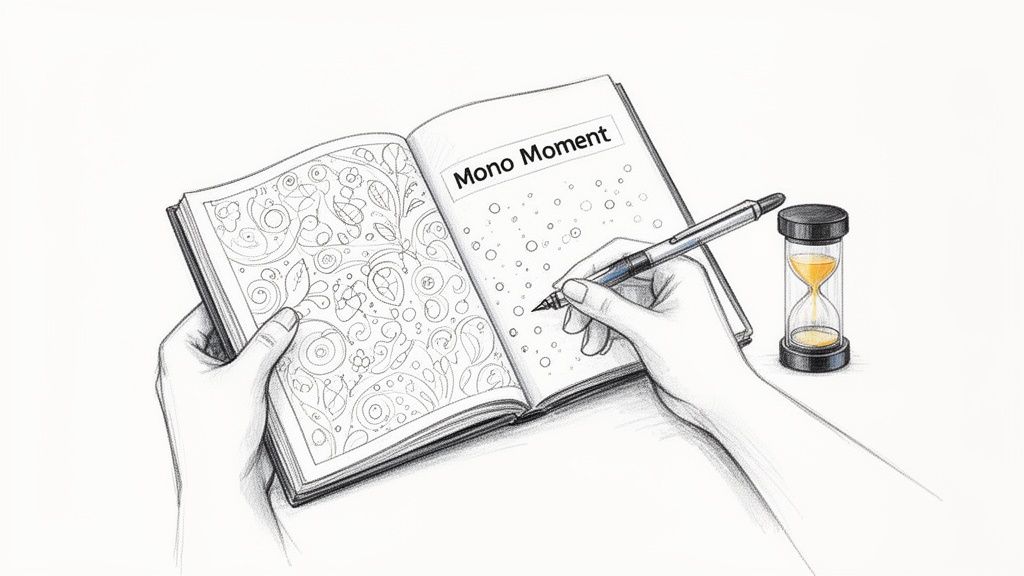
A great way to start quieting that inner critic is to find an activity that takes the pressure off. A simple, decision-free ritual can do wonders for your mindset. It's exactly why we created the Mono Moment One Color Coloring Book. By taking color choices completely out of the equation, it helps you tap into a state of creative flow without that constant fear of getting it "wrong."
This small act helps retrain your brain to value the process, not just the final product. If this is something you wrestle with, our guide on how to stop perfectionism has even more strategies to help you break free.
Create a Ritual to Calm Your Overactive Mind
When your brain is stuck in a loop of pros, cons, and endless "what-ifs," trying to think harder is usually the worst thing you can do. The most effective move is often to deliberately stop thinking altogether. A simple, grounding ritual can act as a circuit breaker for that frantic mental spin, giving you the space and clarity you need to finally move forward.
This is where a decision-free ritual becomes your secret weapon. The whole point is to give your brain a task so simple and structured that it literally doesn't have room to worry. This isn't just about distraction; it's about intentionally creating a pocket of quiet in all that mental noise.
Unwind with a Decision-Free Creative Flow
We created the Mono Moment One Color Coloring Book for this exact reason—as a direct antidote to the mental fatigue that fuels analysis paralysis. By removing the choice of color, we've eliminated a huge source of pressure and perfectionism. You don’t have to agonize over picking the “right” shade or wonder if your color palette looks good.
There’s only one choice left for you to make: pick up a single pen.
That tiny limitation is surprisingly liberating. It lets you sink into a calming, creative flow. Your only job is to fill in the beautiful illustrations on thick, bleed-proof paper. The simple, repetitive motion of pen on paper is incredibly effective at soothing an overactive mind.
The point of the ritual isn't to solve the problem. It's to create the ideal mental state from which the solution can emerge. A calm mind sees pathways a stressed mind misses.
There's real science behind this. Structured, mindful activities like coloring are known to help quiet down the amygdala—your brain’s fear and anxiety center. When you're stuck in analysis paralysis, your amygdala is often screaming, flagging every single potential negative outcome. A calming ritual helps turn down that alarm, allowing the more logical, clear-headed parts of your brain to come back online.
How to Build Your Calming Ritual
Putting this into practice is easy. The next time you feel completely gridlocked on a decision, don't try to force it. Instead, commit to a 20-minute break.
- Step Away: Get up and physically move away from your computer, your notebook, or whatever is feeding the overthinking.
- Set a Timer: Use your phone to set a 20-minute timer. This gives your break a clear beginning and end.
- Engage Your Senses: Open your Mono Moment One Color Coloring Book. Feel the texture of the premium paper and choose your single pen.
- Just Start: Begin filling in the lines. Don’t worry about being perfect or creating a masterpiece. The only goal is the gentle motion.
You'll probably notice your breathing slows down, your shoulders drop, and the mental chatter starts to fade. It’s a form of active meditation that doesn’t require any special training, just a willingness to press pause. You're giving your overworked decision-making circuits a much-needed rest.
When the timer goes off, you can return to the problem with a fresh set of eyes. Often, the decision doesn't seem so monumental anymore, and the best path forward might suddenly feel obvious. For anyone wondering how to overcome analysis paralysis when logic alone fails, this deliberate pause is a game-changer. For more ideas on managing mental overload, you might find our guide on how to calm an overactive mind helpful.
Your Daily Toolkit for Beating Overthinking
Let's be real: you're not going to conquer analysis paralysis with one heroic effort. It’s not about finding a magic bullet. It's about building an arsenal of small, consistent habits that slowly but surely build unstoppable momentum. Think of this as your practical, day-to-day toolkit for breaking the cycle of getting stuck in your own head.
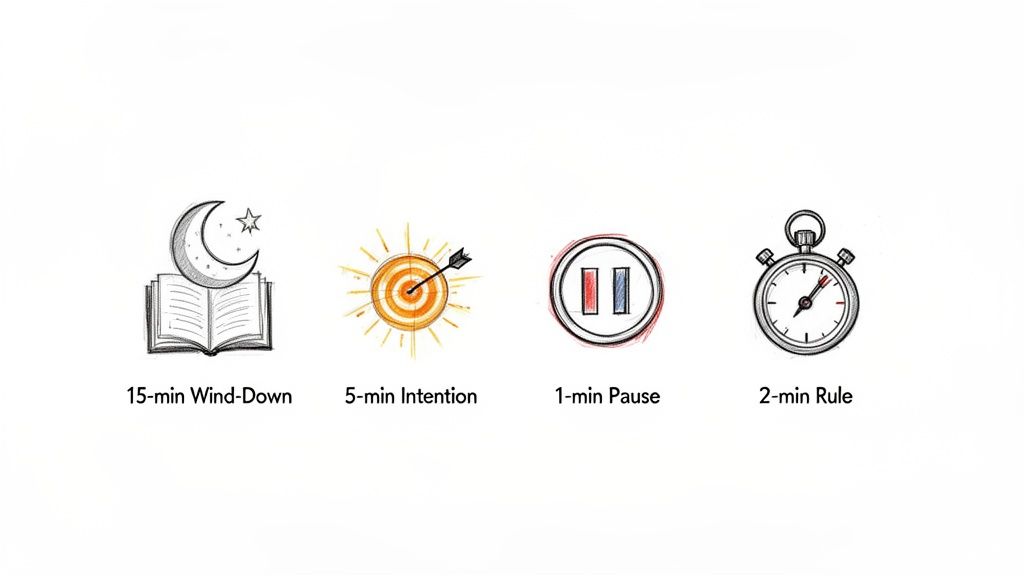
Forget waiting for a lightning bolt of motivation. Instead, you can weave these dead-simple practices into your daily life to keep your mind clear and your focus squarely on what's next.
The 15-Minute Evening Wind-Down
How you end your day is just as important as how you start it. If you crawl into bed with a mind still buzzing with a thousand what-ifs, you’re just setting yourself up to wake up in the same state of overwhelm. A structured wind-down is your best defense against this cycle.
For just 15 minutes before bed, put the screens away. Grab a Mono Moment One Color Coloring Book and a single pen. Because you’re not choosing colors, your brain gets an instant reprieve from making one more decision. The simple, repetitive motion of filling in patterns on that premium, bleed-proof paper acts as a form of active meditation, calming your entire nervous system.
This isn't just busywork. It's a deliberate ritual to clear out your mental cache from the day. You’re prepping your mind for genuinely restful sleep, ensuring today's indecision doesn't bleed into tomorrow.
The 5-Minute Morning Intention
The first few moments after you wake up can dictate the trajectory of your entire day. Most of us make the mistake of immediately grabbing our phones, which instantly throws us into a reactive, defensive posture against the world's demands. Instead, take five minutes to be proactive.
Before you even glance at a screen, sit down with a notebook and ask yourself one simple question: "What is the one most important thing I need to get done today?"
This isn’t about drafting an exhaustive to-do list that will just overwhelm you later. It’s about finding your North Star for the day. Defining that single priority prevents your focus from splintering and makes it so much easier to push aside the distractions that feed overthinking.
Micro-Habits for Midday Overwhelm
Even with the best morning routine, decision fatigue can sneak up on you by lunchtime. When you feel that familiar sensation of being stuck, spinning your wheels on a problem, you need a quick pattern interrupt to break the loop.
Here are two incredibly effective micro-habits to pull you out of the rut:
- The One-Minute Pause: The second you feel that wave of overwhelm rising, just stop. Close your eyes. Take three slow, deep, deliberate breaths. This tiny act is often all it takes to break the anxiety spiral, giving you just enough mental space to see the next logical step forward.
- The Two-Minute Rule: Popularized by productivity guru David Allen, this one is a game-changer. If a task takes less than two minutes to complete, do it right now. Answering that quick email, making that phone call, tidying that one spot on your desk—it prevents the little things from piling up and becoming a source of major mental clutter.
Building a resilient mindset doesn't happen overnight. It happens one small, deliberate action at a time. Your daily toolkit is what turns the abstract goal of "stop overthinking" into a concrete, repeatable practice.
None of these routines are complicated, and that’s precisely why they work. They are simple, accessible tools designed to build the habit of action. Pick just one to start with this week. You might be surprised at the ripple effect it has, making it easier to face bigger decisions with clarity and confidence.
Questions That Come Up When You Start to Break Free
As you begin to untangle yourself from overthinking, a few common questions and mental hurdles are bound to pop up. Here’s how to navigate those tricky moments and stay on track.
How Do I Know if It's Smart Planning or Just Analysis Paralysis?
This is a great question, and the answer comes down to one word: momentum.
Careful planning feels productive. It’s an active, forward-moving process where you gather just enough information to make a confident choice. It has a finish line.
Analysis paralysis, on the other hand, is a hamster wheel. You’re spinning in place, revisiting the same pros and cons, second-guessing your gut, and never actually feeling closer to a decision. If your "research" consistently ends in more anxiety and inaction, not clarity, that's your sign you're stuck.
A simple trick? Give your research a hard stop. Decide you'll spend one hour, or one afternoon, gathering info, and when the timer goes off, you make a call with what you have.
But What If I Choose Wrong?
Ah, the million-dollar question. This fear is the very engine of overthinking. The most powerful reframe here is realizing that indecision is still a decision—it's the decision to stay put, and it almost always comes with the high cost of missed opportunities and mounting stress.
Try adopting what Jeff Bezos calls a "two-way door" mindset. Most of our decisions aren't permanent. You can walk through the door, and if it doesn't work out, you can almost always walk right back out, adjust, and try another door.
Don't see these outcomes as failures. See them as valuable data. Every choice, good or bad, sharpens your judgment for the future. The goal isn't perfect, flawless decisions; it's building resilience and simply moving forward.
The most valuable lessons don't come from getting it right the first time. They come from having the courage to make a choice, learn from the result, and try again with new insight.
Can Something as Simple as Coloring Actually Help a Complex Problem?
It sounds almost too simple to work, but yes. Absolutely.
Think of it this way: analysis paralysis isn't just a logical problem; it's an emotional one. Your brain is stuck in an anxious, overactive state. A simple, focused activity like coloring from our Mono Moment One Color Coloring Book acts as a circuit breaker for that agitated mental state.
By taking the choice of color completely off the table, it instantly removes a layer of decision-making and the pressure to create something "perfect." The gentle, repetitive motion of filling in a pattern is almost meditative. It quiets your brain's fear center (the amygdala) and gives your prefrontal cortex—the part responsible for rational thought—a chance to breathe.
This 20-minute mental reset doesn't magically solve your problem, but it drains the anxiety out of the equation. You can then return to the decision with a much calmer, clearer head.
Ready to find your calm and break the cycle of overthinking? The Mono Moment One Color Coloring Book is designed to be your decision-free escape. Experience the relief of a quiet mind and rediscover your clarity, one pen stroke at a time.
Find your focus with the One Color Coloring Book today!

The One Color Coloring Book
A single-pen, decision-free coloring book on 160 gsm cream paper — engineered for the wind-down ritual described above.
 Pair it with the 3 Dual Tip Brush Pens — $5 instead of $9.95 in the Book + Pens bundle.