Tests every pen, paper and design she recommends — most evenings around 10:30pm.
Published September 6, 2026 · 5 min read
In this article · 6 sections
TL;DR. You don't stop scrolling with willpower; you stop with a replacement that asks even less of you than the phone does. Below are 15 things to do instead of scrolling, sorted by the energy you actually have: zero-effort resets for the nights you're wrecked, small rituals for average nights, and a 20-minute anchor that can replace the phone entirely. The best swap I've found: one page of a one-color coloring book, because it gives your hands the same small satisfying loop with none of the noise.
Here's the honest thing about "just put your phone down." I've tried it for years. It works for about four minutes, and then the phone is back in my hand and I have no memory of picking it up. The problem was never willpower. Scrolling is the lowest-effort activity on Earth, and my evening brain is out of effort. Telling a tired mind to do nothing is telling it to scroll.
What finally worked was accepting that and building a list of replacements that ask less of me than the phone does. Not more interesting, not more productive, just easier, and better to wake up from. This is that list, sorted by how much energy you actually have on a given night, because the swap has to match the tank.
Tier 1: zero energy (the nights you're wrecked)
These require no decisions, no setup, and no skill. If you can hold a phone, you can do these.
- Phone in another room, then tea. The distance is the trick. Getting up to check it is just enough friction to not bother. The tea gives your hands the next thing to hold.
- Lights down to one lamp. Overhead light is input. One warm lamp changes the whole evening's temperature, and it takes five seconds.
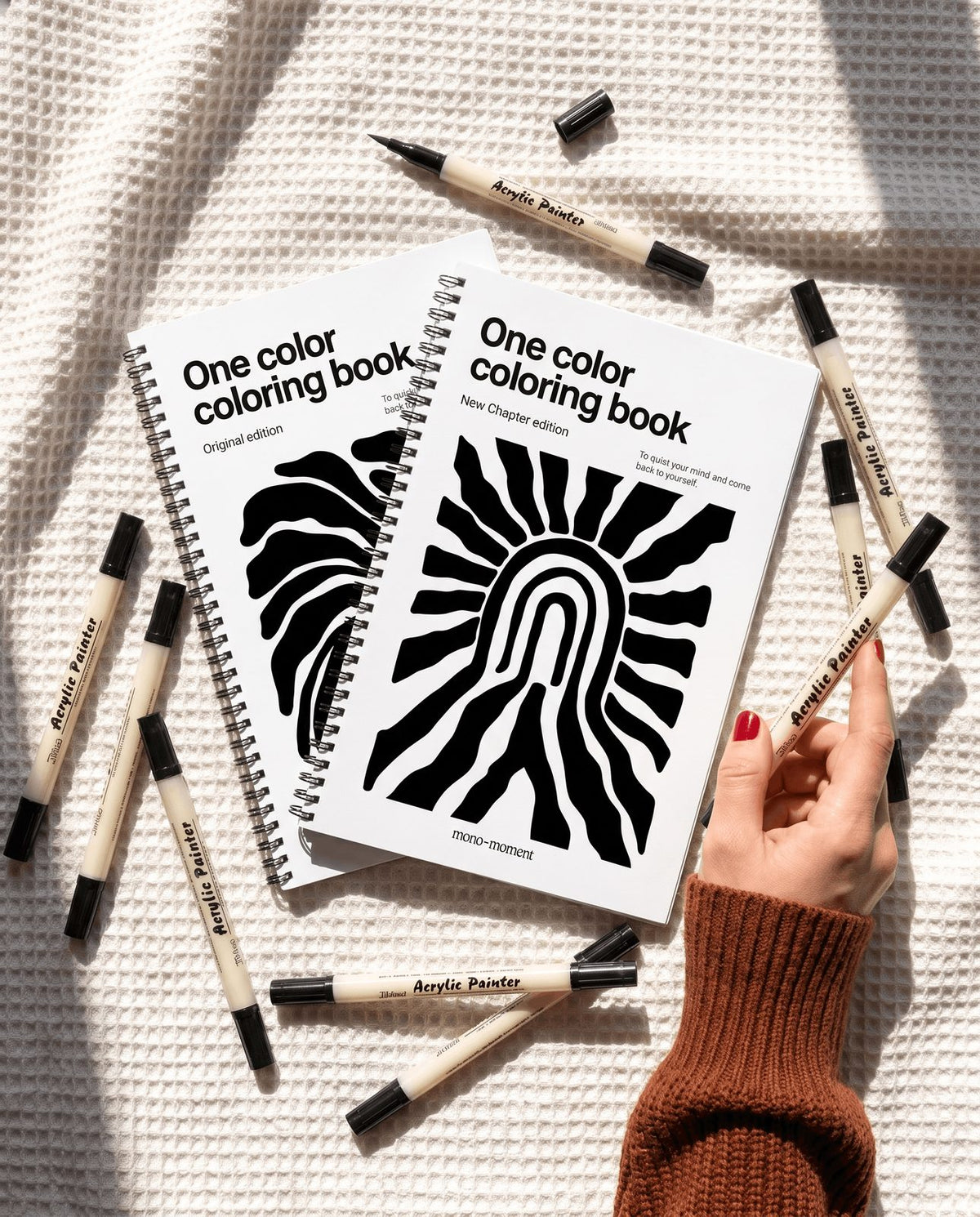
- Fill one page of a one-color coloring book. This is my anchor, so I'll explain it properly further down. Short version: one pen, bold closed shapes, small marked zones that tell you what to fill. No color decisions, no planning, no way to do it wrong. It gives your hands the small repetitive satisfaction that scrolling gives, without the noise.
- Lie on the floor with a blanket for ten minutes. It sounds absurd. It's a reset. Something about the hard surface and the ceiling stops the loop.
- Window and nothing. Sit near a window, lights low, and look out. Ten minutes of no input is a real activity when your brain has had fourteen hours of it.
Tier 2: a little energy (average nights)

- A shower you're actually in. Not the rushed morning one. Warm, long, phone nowhere near it.
- One song, eyes closed. Pick one album track, not a playlist (a playlist is decisions). Sit and listen to the whole thing.
- Hand-write tomorrow's three things. A pen and a scrap of paper. Getting the list out of your head is half the reason you were scrolling in the first place; it's avoidance of the loop.
- Stretch on the floor for the length of one song. No routine, no app. Just what feels stiff.
- A puzzle you can leave out. A jigsaw on a tray is the analog infinite scroll: small satisfying actions, no end state required, no notifications.
Tier 3: a 20-minute ritual (the nights you can build something)
- Read ten pages of a physical book. Ten, not "a chapter." The small number makes it startable.
- Cook something slow for tomorrow. Overnight oats, a soup. Hands busy, mind on a simple sequence.
- Knit a basic stitch or crochet a row. Repetitive, tactile, and it produces something. The learning curve is the only obstacle, which is why coloring gets my vote for beginners.
- Walk the block without a podcast. Just walk. The podcast is scrolling for your ears.
- Call someone instead of texting. A real voice for ten minutes does more for a lonely-scrolling night than an hour of feeds.
Why the coloring swap works better than the others

I've kept number three in the zero-energy tier on purpose, because it's the one that replaced scrolling for me rather than just interrupting it. Here's the mechanism.
Scrolling gives you a loop: small action, small reward, repeat. It's soothing because it's effortless and endless. Most alternatives fail because they break the loop without replacing it: reading asks for attention, journaling asks for honesty, meditation asks you to sit with the exact thoughts you were scrolling to avoid.
One-color coloring keeps the loop and removes the noise. You fill one shape, it looks done, you fill the next. The One Color Coloring Book is built around this: 65 bold designs, one pen, little stars marking each zone so there's nothing to decide. There's science under it too. A study on art making found that around 45 minutes lowered cortisol in roughly three-quarters of participants, regardless of skill. And Cleveland Clinic's description of decision fatigue explains why the "one color" part matters: an evening brain has no decisions left, and a traditional coloring book with 40 pencils asks for dozens per page. One pen asks for none.
Twenty minutes, one page, phone in the other room. My screen time dropped by about an hour a night, and the part I didn't expect is that I sleep better, because the evening ends quiet instead of ending mid-feed. If nights are when the thinking gets loudest, how to stop overthinking at night covers the mental side of the same problem.
How to actually make the swap stick
Three rules that made the difference between a good intention and a habit:
- Replace the moment, not the phone. The scroll is anchored to a moment: couch after dinner, bed before sleep. Keep the moment, change the action. Same couch, book instead of phone.
- Set the bar embarrassingly low. One page. One cup. One song. The number one is what makes it startable on a wrecked night, and once you've started, you usually continue.
- Keep the replacement where the phone used to be. My book lives on the coffee table, pen clipped to the spiral. If it's in a drawer, the phone wins. Nothing beats a phone on convenience except something that's already in your hand.
If you want more options in the same spirit, low-stimulation activities is the longer list, and wind down before bed covers the last hour specifically.
The one thing to try tonight

Don't try the list. Try one. Put the phone in the kitchen, make tea, and fill one page of something with one pen. If you don't have the book, a plain notebook and a single marker will show you the mechanism. The point isn't the object. The point is ending one evening with your head quieter than it started, and noticing that you didn't miss the feed at all.

The One Color Coloring Book
65+ bold designs, one single color, zero decisions — on 160 gsm paper with a lay-flat spiral, engineered for the wind-down ritual described above.
 Pair it with the 3 Dual Tip Brush Pens — $5 instead of $9.95 in the Book + Pens bundle.
Sources & further reading
Frequently asked questions
Why is it so hard to stop scrolling at night?
What can I do instead of scrolling that takes no energy?
How long does it take to break the scrolling habit?
Is coloring really a good alternative to scrolling?
What if I scroll because I'm too tired to do anything else?
Know someone who needs a quieter evening? Pin it · Share on Facebook ·
↑